This week was a lot of reflection time, evaluating my progress, and thinking ahead about how I need to proceed with my work. The video project opened a lot of avenues for me to reflect on and assess things regarding my process. Let’s take a deeper dive into what that looked like!
Thesis Video Project Reflection:
Everyone did an amazing job with their projects. There was such a variety of ideas that came through, and my favorite part was seeing how effectively everyone summed up their projects into a short video format, because I think that’s what I had the most difficulty with. I loved the subtle use of humor in each project, and I wonder if they will continue to expand on the ideas they showed in the videos. The feedback and comments we all had for each individual project were not only helpful for the project we were discussing at the time, but also as general guidance for everyone, or at least that’s how I saw those sessions of feedback. I took a little bit from every project to reflect on my own and see where I lacked. I am not necessarily proud of what I came up with, but that doesn’t mean I didn’t learn anything. Even though the outcome was nowhere near how I wanted, I still call it a win considering the amount of clarity it brought me. My ideas did not come through very well, and I now know why. I was trying to do too much for the quick turnaround time, wanting to cover every tiny detail of my thesis in detail, rather than giving a general overview of what I am doing. If I had focused on one primary aspect and gone with a conceptual and indirect approach, I think I would have come up with something more successful. Other than that, it also made me reevaluate some parts of my thesis that are hitting roadblocks and taking more time than they should. I have been thinking and reflecting on my progress so far, as well as what I will need to do soon, all the time. I am thinking about and coming up with questions and solutions anywhere and anytime: while making breakfast, at the gym, on the bus, on a walk, in the shower, and even at times waking up in the middle of the night. All things considered, this project gave me a lot of considerations, clarity, and questions that I can discuss in my thesis committee meeting next week.
What I worked on:
Thesis Presentation 1:
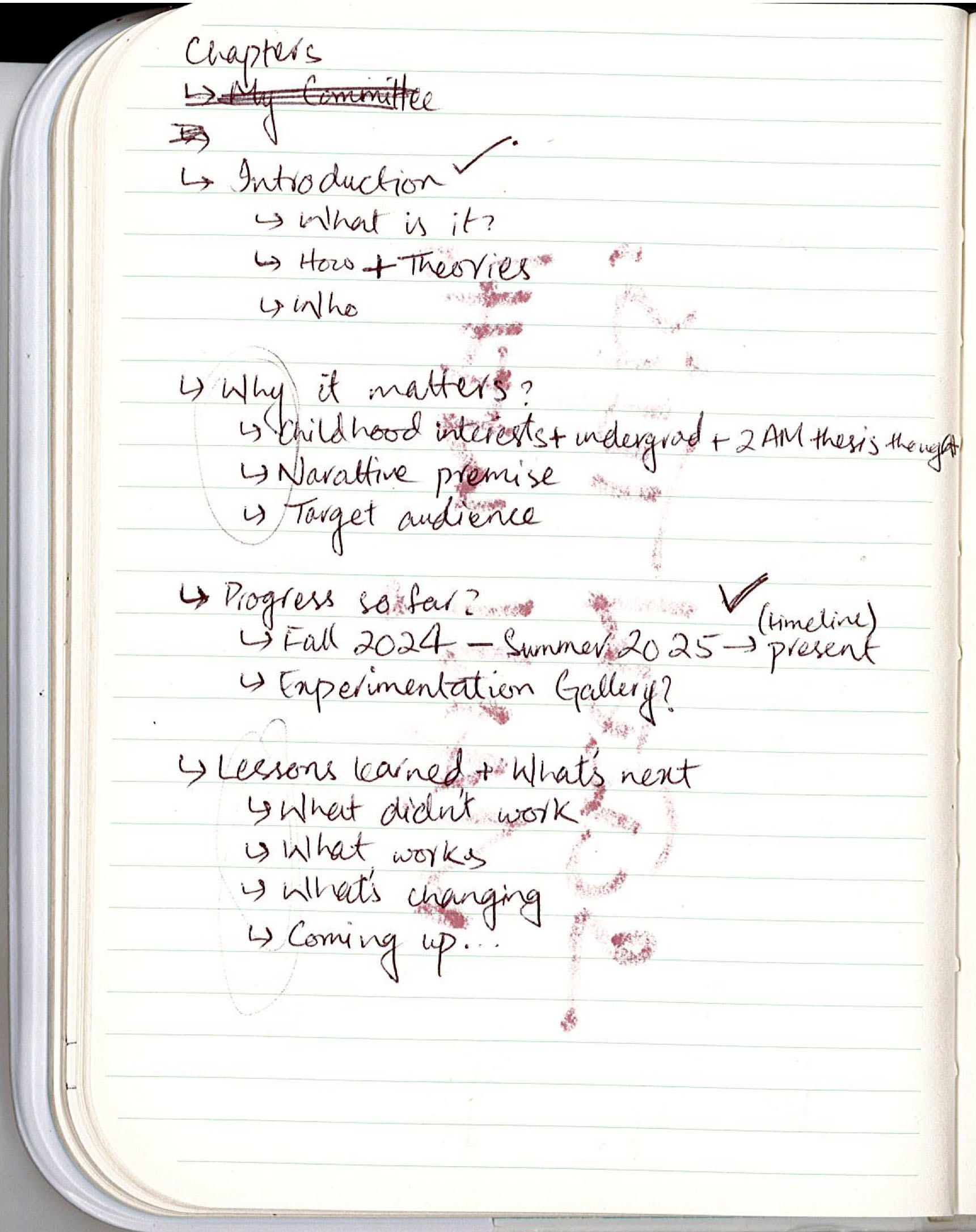
For the presentation, I thought I’d kill two birds with one stone. One very crucial thing to do on my list for thesis was to build a prototype to test my proposed gameplay mechanics, so I figured I’d shape my midterm presentation in a way that it works as if I am playing through a game like what I am working on for the actual thesis. The idea is to structure the presentation like a comic you can play through, and the content is simply the progress I have made on my thesis so far. To start things off, I listed out the things I need to include in my presentation. After that, I categorized everything into “chapters” of sorts so I can have them accessible through different parts of the “game”, for example: clicking on “New Game” would take you through a “tutorial” section which would just be a simple introduction to what my project is about, just like in an actual game sometimes when you start a new game, it takes you through an introductory tutorial to get you familiarized with the game.
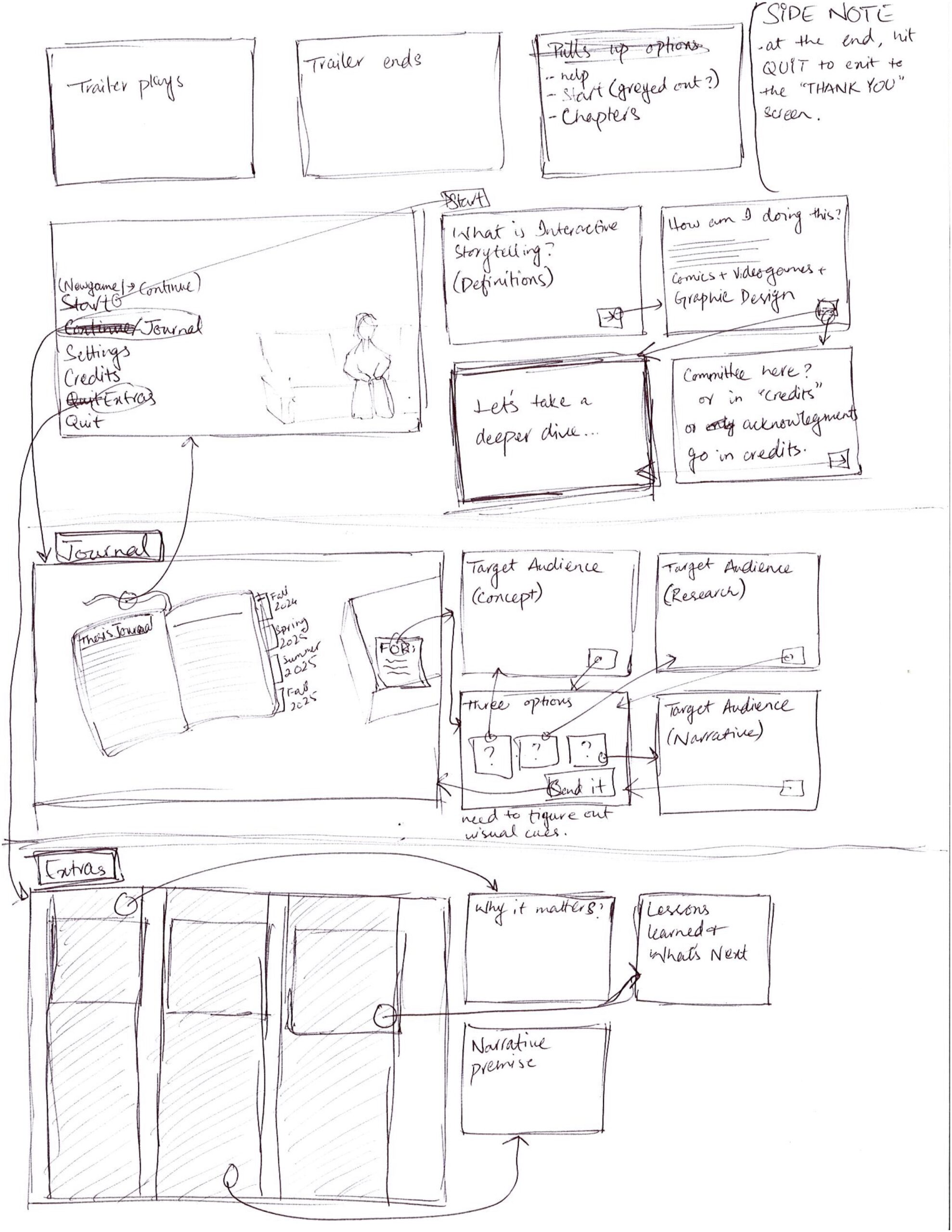
Once I had everything listed out, I started doing a very rough, first-draft sketch to visualize everything and transfer it from my mind to a tangible format. This helped me narrow down things, categorize them properly, and structure them in a way that makes sense as a prototype of sorts. This phase came through after a certain number of scribbles and iterations, seeing what works and what doesn’t in terms of organizing and accessing different parts of the presentation material. I don’t know if I would call this phase a storyboard or a wireframe sketch, as it sort of acts like both. Let’s just stick with “rough sketch” for now. This rough sketch gave me the grounds to work on it further and start flushing it out into a wireframe and a relatively neat storyboard, perhaps. Once that gets done, I am hoping it gives me a sense of how much visual detail I want my presentation to have based on how much time I have. So far, my safe plan is to have each “title” screen to be gamified and visually complete to serve as an actual good-looking screen, and then the informational content could just be formatted as “presentation slides” so I am not running into the same problem as my thesis video, i.e., taking on so much work that the quality gets lost.
Character Design – Antagonist
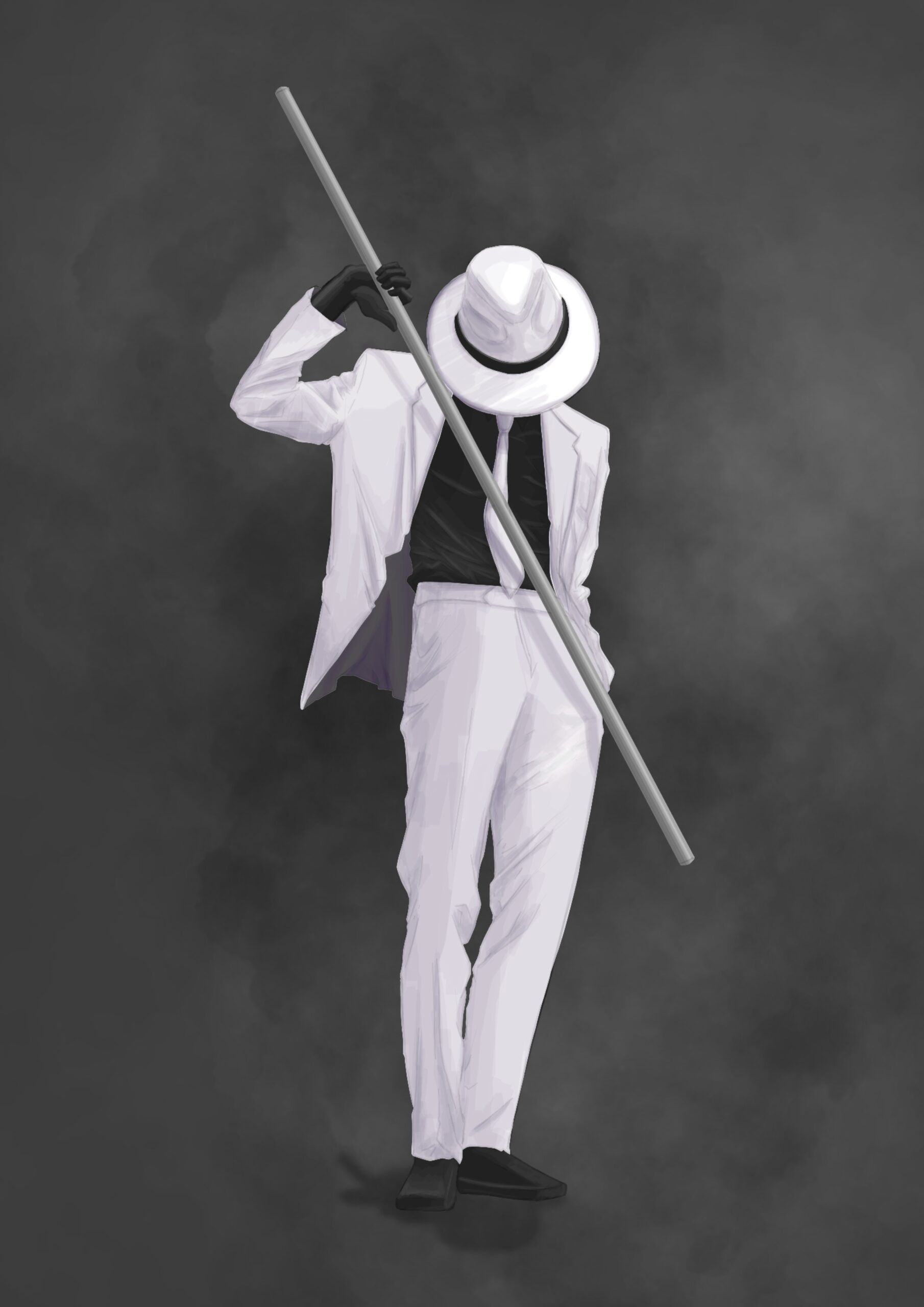
The antagonist character that I sketched out a few days ago is finally coming to life (figuratively, of course) as I start to render it out in a rather painterly style, unlike my regular art style. I was thinking of what I wanted him to look and feel like, and I picked a Procreate brush, turned the opacity down to 5%, and just went with it with a goal to have fun and make mistakes with it. Being that the character is the embodiment of difficulties, mental trauma, stress, and anxiety, I wanted it to have a rather rough and sketchy finish. To achieve that texture and that aesthetic, I thought to myself, DO NOT USE AN ERASER OR UNDO while working on this. If I make a mistake, it will live through; if I make rough construction lines, they will live through; if I accidentally color outside the sketchy linework, it will remain that way. This approach made me have fun freely without having to worry about perfection, and it made me increasingly confident about what I was doing. I think this technique could also be taught as an exercise to build confidence.
As I add the finishing touches to this character, I think I will figure out how he appears in various scenes, how he interacts with the story and other characters, and what other roles he could eventually play in the story. I still need a name for this guy, but I don’t want to rush that part, so I will figure that out as I go.
What I watched:
The Art of Video Game Title Screens
https://www.youtube.com/watch?v=pi47bBT4G9Q
While this week was about reflection and iterations, I didn’t get too much into watching or reading reference material. However, I did watch one video while working on my presentation outline sketch. I put it on just as background noise, but then things got interesting, and I actually watched it analytically, and it had some good insights that helped me come up with ideas and got me out of a potential creative block. My takeaway from this was that I don’t need to think too hard about what my main menu or title screen needs to look like, focusing on design and gameplay principles. It can actually be however I want it to be, as long as it makes sense with the context that I am working in. This helped me get out of that “Stuck” feeling where we focus too much on the details of perfectionism, and get on with it, and I think that was very helpful for me personally.
Coming up next…
- In the next week, I will be refining my presentation sketch into a relatively neat wireframe. I am thinking of maybe using Twine again for this since I used it to structure my script early on. If that doesn’t work, I might try Figma, and from there, I can directly move into making a Lo-Fi prototype for the presentation.
- I have a second trailer video I have been working on. I will try to refine that further and see if I can finish it on time to put that at the start of my presentation as a cinematic of sorts.
- As I work on the presentation material, I will also be actively thinking about the visual styles for my presentation and creating a moodboard of sorts to help with inspiration.