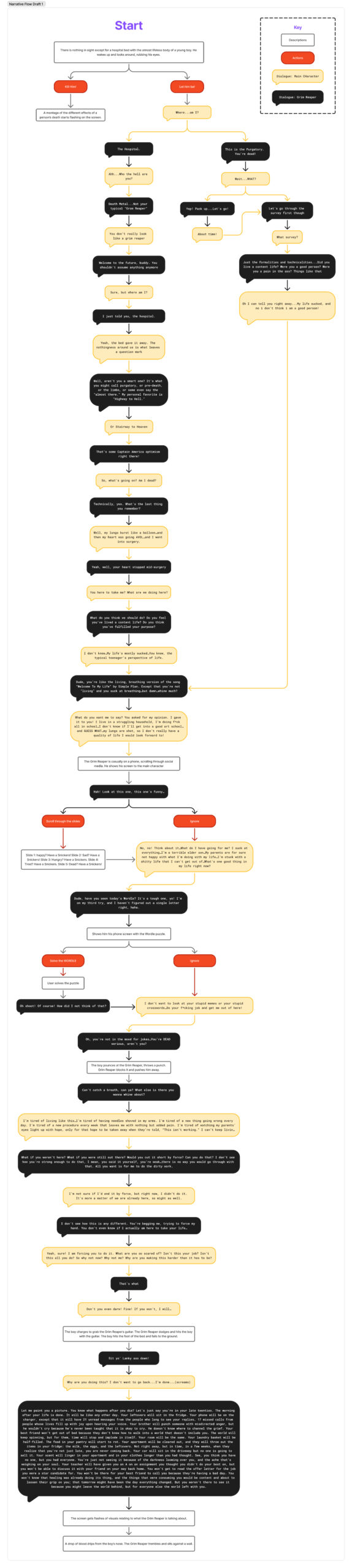
This week, I finished “The Purgatory,” which is one of the parts of the bigger narrative for my game. While putting that script in a flowchart on Figma, incorporating the choices that the user would get to play through the experience. I laid it all out in a flowchart format as the first draft of the flow.
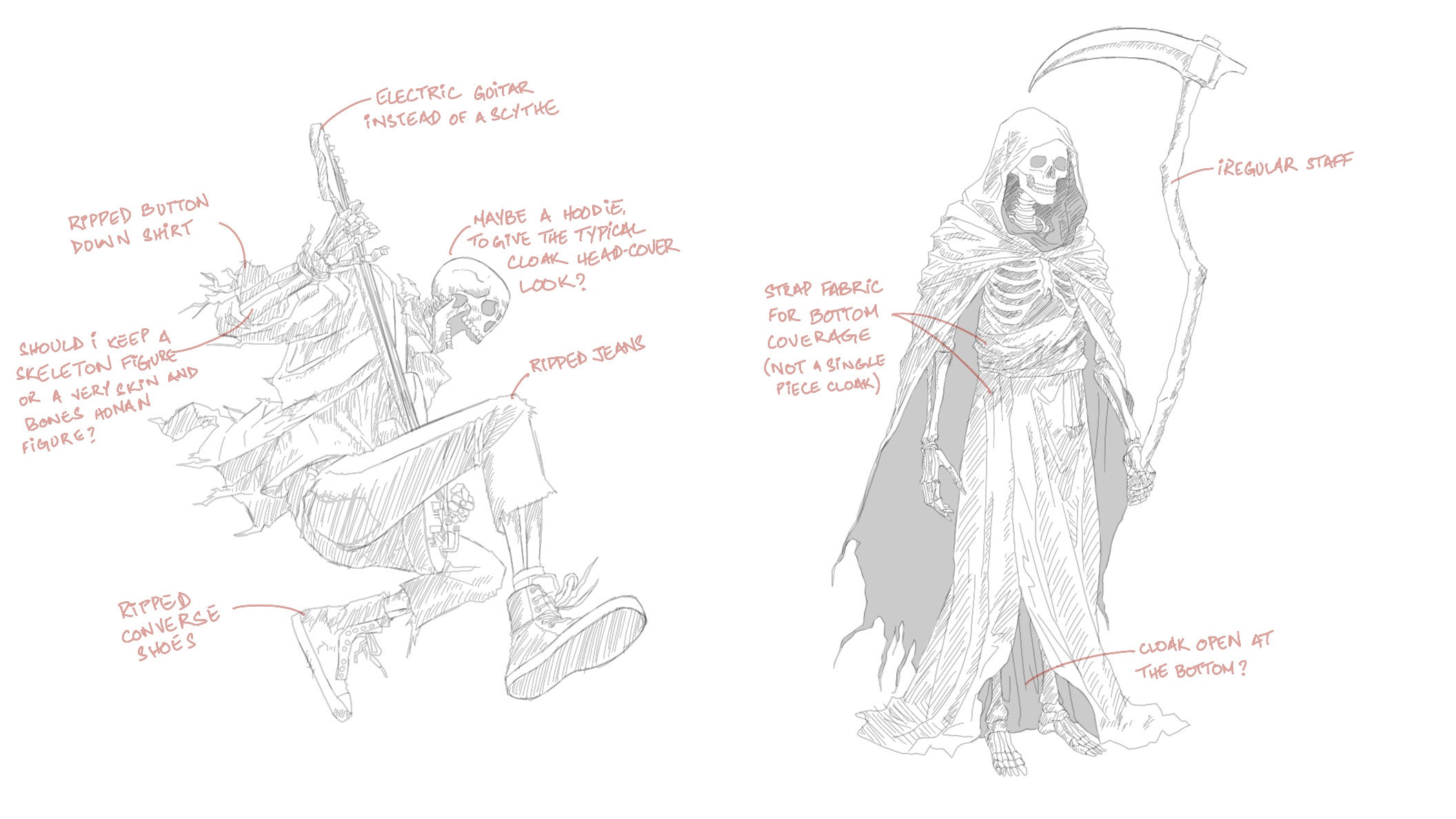
The narrative starts with the main character waking up in a hospital bed, but there is nothing around him but the Grim Reaper, who is dressed in the same clothes as the main character, but ripped and torn, with an electric guitar on him. I chose this visual representation of the Grim Reaper to steer away from the typical skeleton in a big black cloak and a scythe. The user gets to play as the Grim Reaper at this point in the story. The reason behind that is that the main moral of the story is delivered through the Grim Reaper, and by giving the user that role, it becomes a reflection of the idea that you learn these lessons through your life experiences. At the very start, the user is given the choice to kill the main character or to let him be. The reason why you get the choice of killing the main character right away is for some light, witty humor, AND the fact that if you end the game right away, you will play it again to see what actually happens and the moral might be more impactful the second time around as a “second chance at life,” just like the character gets by the end of this part of the story.
Once you go through the choice of not killing the main character, you go through a conversation between the main character and the Grim Reaper. The main character is going through the typical stage of his life where he is a teenager, going through a spectrum of emotions, thinking that his life is not worth living. He fails to recognize the true essence of life and doesn’t see the bigger picture. The Grim Reaper keeps triggering the main character at different points in the conversation, trying to confuse his emotions, much like a raigbait. At different points, to break the conversation and give the user a chance to interact with the story. The first one is the Grim Reaper showing the main character a meme on his phone, where the user can either go through the five slides of the meme or choose to ignore it. The second one is the Grim Reaper going through a Wordle puzzle that he is unable to solve, and again, the user can either solve it or choose to ignore it. After a few exchanges of dialogue, the Grim Reaper finally breaks and starts to talk about the aftermath of death, talking about what happens to the world that you built around you after you’re gone. After giving the emotionally heavy speech, the Grim Reaper is seen physically struggling as he leans against something for support. I still have to figure out a well-fitting ending to the narrative at this point.
Character Sketches:
While brainstorming different ideas for the Grim Reaper’s visual appearance, I shortlisted two options: the typical skeleton in a long cloak holding a scythe, and a death metal Grim Reaper with an electric guitar instead of a scythe. While I was shortlisting these things, I also had another thought that came from my Independent Study with Austin, where we figured that it might be conceptually strong to have each of the side characters (the Grim Reaper, the Protective Dissociation, and the Personification of Mental stress), to be versions of the main character since a lot of the resilience and growth is done through careful self-reflection and self-assessment. The idea is that as you grow, you experience things and your perception matures with those experiences. So to shortlist the ideas and sketching them out, I chose the death metal punk rock Grim Reaper, and the typical traditional version. Upon sketching these out, I settled on the death metal punk rock version, since that could also be framed in the same attire as the main character to give a sense of similarity as if both the characters are different personifications of the same person. The next part to complete the character ideation would be to design the main character as well, so I can give the same attire in a slightly ripped and worn treatment, to the Grim Reaper.
Some hurdles along the way:
I give extra points to my brain for always running and processing things in the backend. This weird and extremely productive way of working with information came up with some quite serious problems and hurdles that I might end up running into. One of the major issues I identified as I abruptly woke up at 2:07 AM one night, was that I can not efficiently run soundtracks and music with my prototype due to a limitation in Figma. Figma can only play sound when it is accompanied by a video file. Which is not very difficult to work around: I could simply add a blank video and set its transparency to zero or I could place it under all the layers so it isn’t visible in the frame; easy peasy lemon squeezy. However, that is not the issue that woke me up that late at night; I eoke up to a realization that Figma can not play music that would flow seamlessly from frame to frame. Every interaction in the prototype would potentially change frames, and once I change the frame, it will not play the music from the file that was on the previous frame, as it will run everything in the new frame from the start. So to tackle that, I am once again exploring other game engines to see if I can find an alternative to Figma to make a simple point-and-click game. So far I have no luck.
Coming up next…
- This week I am excited to start working on laying out the storyboards from the script to give it the first visual look.
- I am also going to finalize the main character and the Grim Reaper character.
- Other than that, I am also thinking (in the backend, hoping to wake up during the night) of a way to add a trick interaction between the main character and the Grim Reaper’s guitar wherein the main character is trying to get to the guitar to kill himself and how the Grim Reaper casually prevents that from happening.