What I watched:
The Beautiful and the Ugly | Lil’ Huddy and Art
https://www.youtube.com/watch?v=Hl_y2i-OJrQ
I stumbled upon this video at the right time, exactly when I needed it. I got (almost) done with one of my artworks, and I started having the “I don’t like it…” crisis, so I took a step away from my iPad and started browsing through YouTube. That’s when I found this neat little video. He had such amazing and profound concepts covered in this video, and they all just made sense in the moment (they still do). He talks about how an aesthetic that you’re not comfortable with, one where you can’t make things look just right, can help us create ideas from nothing. We aren’t doing great because we are trying something new that we aren’t comfortable with; hence, we have more potential to do new things and experiment to see what works conceptually. We no longer compare our work to the societal model of standards and expectations. To sum it up I would say if I go against “what looks good” or what “a proper composition” is, there are a lot of conceptual possibilities to work towards. Do I think it is easy? Absolutely not! Am I going to try it? 100 percent I will!
How to draw backgrounds QUICK AND EASY
https://www.youtube.com/watch?v=Md70-o6Iy-Q
I struggle with drawing backgrounds and settings. I always have. Being a detail-oriented person, I get hung up on everything that is visible and start going too much into the details, making everything look “PERFECT”, and in doing so, I waste a lot of time, and it just doesn’t look good. I clicked on this video while I was on my inspiration (digital) stroll, and it gave me the motivation I needed to try working on backgrounds and incorporating the techniques talked about in the video. They were showing how they break things downs into bigger chunks and shapes, giving the impression of textures instead of drawing the tiny details. As I saw their process, I thought how much sense it makes, and it started reminding me how many brilliant artworks I have seen, and it hit me how most of them do the same thing. I am really excited to see how well I can incorporate this into my future work. It will take time and practice, but I am excited to learn!
What I read:
Everything to Play For: How Videogames Change the World by Miriam Did
Reading this book made so much sense of how chaotic but beautiful the game industry and the world around it is. The book touches upon a few things that relate to my thesis as well: how we use storytelling through games to target and talk about emotional truth, connection, and sometimes even healing. What resonated the most with me was the emotions I felt about games when the author talked about games being worth fighting for. They weren’t proposing that we abandon the medium but reclaim it for all its worth. I’m trying to rethink how people engage with narratives by making them the player and creating agency in the story world. She’s arguing for the agency in the real-world system that makes such games possible. Their experiences of gaming as an escape mechanism, bonding, and survival are some of the reasons I am drawn to the medium in the first place. It’s not just storytelling; it is a space for complexity, contradiction, and brewing change!
This book could potentially serve as a guide for my thesis, as it could help me frame the role of the medium within larger systems of power, production, sociopolitical, and cultural influence. It reaffirms my argument that games are not neutral, but they carry strong narratives, ideologies, and emotions. This book will also serve as a reminder for me to stay intentional about the choices I make from visuals to gameplay, and to treat “play” as not just a mode of entertainment. But also a space for empathy, resilience, and growth.
What I worked on:
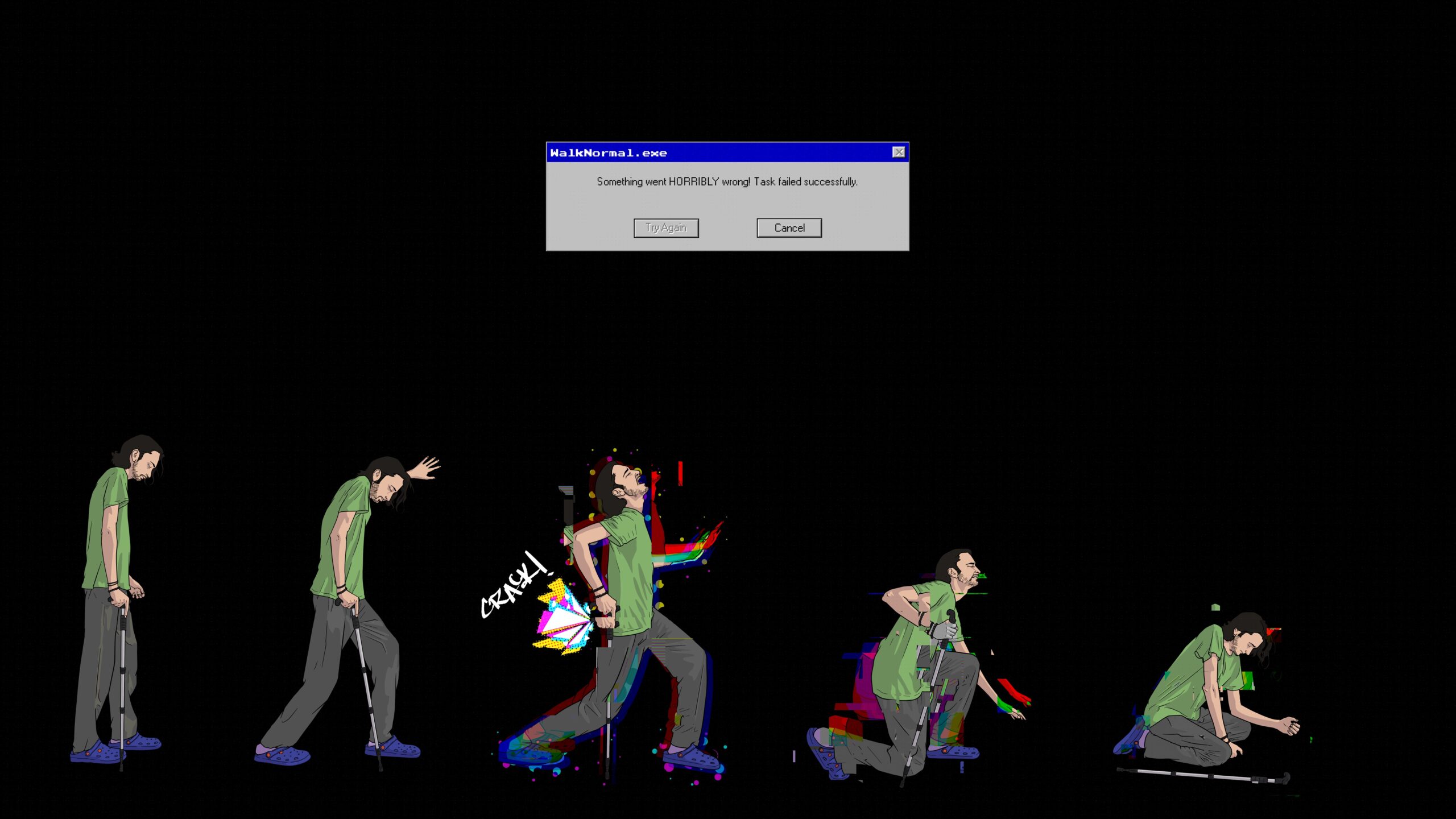
I made this illustration this week. This is a sequence of steps depicting a physical trauma. In this case, it is showing a back muscle pull, which feels and sounds like a crack, but is not actually anything cracking. Throughout the sequence, the character is shown struggling, but the hardship amplifies greatly after the point of impact, which is the third position where the crack actually happens.
There are a lot of things I think I need to change with this one, since it does not really emphasize the point I am trying to make. One of the thoughts I had was to incorporate the Antagonist character in the first and the last step who would become the medium of the message by having a virtual dialogue with the main character: in the first few steps he just tries to convince the main character to not try very hard because there is no point since he is very weak and his body can’t take it. Then I can end the sequence again with the antagonist telling the main character, “I told you so”, making him feel bad about trying to do better. I think this would show the message rather clearer.
The next main thing in this illustration is the background. I don’t like the solid black. It shows up as if something is missing, which I think it is. I have a few ideas I could try out. Austin advised that I go with something like a pixel grid from the old monitor screens, so that the error message also seems relevant. In a discussion with Tina, we came up with a few ideas as well. I could do a drapery of a projector screen with the pixel grid as well. Or I could do big comic book style panels with the antagonist in them, having a virtual dialogue with the main character every step of the way. I’m not sure as of right now what might work and what might not. I am open to suggestions here. I do know that I will try a few things out and see if something sticks!
Thesis Video:
For the next class project, we are supposed to make a video that explains our thesis without us directly talking about our thesis. For that, I am still in the brainstorming phase on this idea I have. I am thinking of making one of those “Day in the Life of…” videos, where I cast myself as the main character, and have sequential shots of my day, including waking up, having breakfast, going out, sitting in class, coming back home, etc. the visual language shifts little by little as we progress through the day, where we see bursts of comic style artwork at some specific points. Eventually, it is all comic-style artworks. I want to make it so it could potentially serve as a piece in my thesis.
Coming up next:
- Next, I will start storyboarding the idea I have for the video to see if it makes sense going forward. Once I have the frames storyboarded, I will start shooting the shots with my phone camera.
- For the “Try Again” artwork, I will try a few things I mentioned to see if they work. Alongside that, I will refine the character design a little more since I plan on incorporating him into the artwork.
- I think I will use my next independent study artwork to make one for the thesis video assignment.